Friday, 24 May 2013
Iron Man 3
I saw Iron Man 3 twice within 24 hours. This is because a) I really liked it and b) I needed to see it one more time to figure out that I liked it. It wasn't that I didn't enjoy it the first time around it's just that, like so many others, I had high expectations and I wasn't sure whether it reached those expectations.
The film is explosive in many ways, and subtle in others. It far surpasses the weaker Iron Man 2, but I don't think I could say that it's better than the first one. Jon Favreau's 2008 hit felt as though it came out of nowhere and for that reason it set the bar for every other Marvel film that followed. Shane Black's take on Iron Man is a little darker. We find Tony Stark where we last left him in The Avengers, although this time there's less cheek and more internal struggle. After his near-fatal return to Earth in the 2012 blockbuster, Stark finds himself suffering from PTSD. Unable to sleep he spends his nights tinkering with his 'toys', building numerous iron man suits and worrying his now live-in girlfriend Pepper Potts. When a villain by the name of The Mandarin poses a threat to America, and Stark himself, he has no choice but to react. What ensues is a lot of action, some great twists and turns, and a chance for Stark to find himself amongst the rubble.
One of the reasons I wasn't sure how I first felt about the film had to do with the fact that Stark is not in the Iron Man suit often in the film. The story follows Stark more than it does Iron Man, and although I wasn't expecting this, I ended up enjoying this aspect. With two other Iron Man films and an Avengers film we've seen Iron Man in many different capacities. It is actually refreshing to see Stark deal with some of his issues outside of the suit.
Rumour has it that Robert Downey Jr. won't return as Iron Man in an Iron Man film. Fear not though, there are more Avengers films to come and he'll most likely be in those. I can't imagine anyone else playing Tony Stark, the role seems to be made for him, and he certainly made the role.
Saturday, 23 March 2013
Underrated Television: The three shows you should be watching, but probably aren't
Sons of Anarchy (Kurt Sutter, 2005-present)
I say this without any reservation. Kurt Sutter's Sons of Anarchy is the best television show I have ever watched. I cannot believe I only just discovered it this year when it's been on the air since 2005. This is without a doubt the most underrated television show.
IMDb states that the premise as: "A man in his early 30s struggles to find a balance in his life between being a new dad and his involvement in a motorcycle club." This doesn't really do the show any justice though. Jax Teller (Charlie Hunnam) is vice-president to the motorcycle club the Sons of Anarchy. They are much more than mere motorcycle enthusiasts however, with their arms reaching into guns, drugs, Mexican cartels and the IRA. His step-father, Clay Morrow (Ron Pearlman) is the club's President, and although things start out well between Clay and Jax, they quickly unravel after Jax discovers a manifest written by his late father John, who had a different vision for the club. Jax's life is further complicated by his drug addicted ex-wife, premature son Abel, and the return of his high school girlfriend and true love Tara (Maggie Siff), who is now a doctor.
Although Jax is arguably the show's main character, the others are not left by the wayside. Each character is explored throughout the series. Gemma is played by the highly talented Katy Sagal, who is married to Kurt Sutter. She is both mother to Jax and matriarch to the club.
Throughout the five seasons each character is tested and no one is the same once we reach the end of season five. I was able to watch all the seasons back to back, but now I, like so many fans, eagerly await the next season. One thing is for sure, on this show anything can happen.
Justified (2010-present)
Like Sons of Anarchy, Justified plays on the FX channel. And like Sons of Anarchy it is highly underrated.
IMDb lists the premise as: "Old-school U.S. Marshal Raylan Givens is reassigned from Miami to his childhood home in the poor, rural coal-mining towns in Eastern Kentucky." To add to this, Raylan (Timothy Olyphant) is a skilled Marshall who dresses like a cowboy, is a quick draw, and has no qualms with shooting people. His Miami boss doesn't take too well to Raylan shooting a felon at an upmarket Miami restaurant during lunch. As punishment he sends Raylan back to Kentucky where he works the small towns, including his own hometown, the notorious Harlan County. Raylan reconnects with people from his past including his criminal father, his ex-wife Winona, and an old coal-mining buddy Boyd Crowder (Walton Goggins), who is Harlan's most charismatic outlaw.
The show is currently in it's fourth season. Each season brings a different criminal source to Harlan that Raylan has to deal with. However the one constant is always Boyd. Raylan and Boyd have an interesting relationship. There are times when it's been Boyd that Raylan's hunting, but for the most part Boyd is a source for Raylan, although there's no love lost between the two men.
The character of Boyd was originally going to be killed off in season one, however it quickly became apparent that he was an asset to the show. I can't imagine Justified without Boyd, it'd be like taking away Raylan's gun.
Elementary (Robert Doherty, 2012-present)
Elementary is Sherlock Holmes with a twist. In this American adaptation Sherlock (Jonny Lee Miller) is a drug addict who has had to leave London and now resides in New York. He works with the local Police Dept., cracking complex cases the only way Sherlock knows how, with frightening intelligence, lack of modesty and limited social skills. The big twist however is that the famous Watson is a woman, played by Lucy Liu, who also happens to be Sherlock's sober companion.
If you think that having Watson played by a woman means a Sherlock/Watson romantic relationship you'd be wrong. The writer's are very careful to keep their relationship platonic. I'm not sure if they'll be able to continue doing this down the road, but so far there is no chemistry between the two.
I was hesitant to start watching this show because I'm not normally a fan of American adaptations of British shows. However, after finishing the two seasons of Sherlock (2010-present, which, if you haven't seen you need to) I was in the mood for some more Sherlock in my life. Miller is very aware of the fact that Benedict Cumberbatch's Sherlock is loved by many fans worldwide, and he has taken care not to mimic him in any way. This Sherlock is not as socially awkward, is more sexual, and has been pulled down a peg or two by his addiction. He's definitely more relatable. It's a really interesting show and so far the relationship between Sherlock and Watson is being explored in a unique way.
So there you have it, three shows that you probably aren't watching but really need to. There's so much crap on television today (cough cough anything with Kim Kardashian cough) and it's a shame that great shows are ignored. One way that can change is by word of mouth. If you find a great show, tell everyone about it. Make sure your favourite shows don't follow so many other greats to the TV cemetery.
Labels:
Charlie Hunnam,
Elementary,
Jonny Lee Miller,
Justified,
Katy Sagal,
Kurt Sutter,
Lucy Liu,
Maggie Siff,
Ron Pearlman,
Sons of Anarchy,
Television,
Timothy Olyphant,
Walton Goggins
Friday, 1 February 2013
Zero Dark Thirty
In posts long overdue I present to you Kathryn Bigelow's Zero Dark Thirty
This film came with a lot of hype, and considering its premise is based around the hunt for Osama Bin Laden that's not a surprise. The main complaint was the use of torture scenes in the film's first half hour. We see our protagonist Maya (Jessica Chastain) arrive at a detainee centre in Pakistan where she watches Dan (Jason Clarke) use waterboarding, depravation and humiliation in his interrogation of a detainee with ties to Saudi terrorists. Was it difficult to watch? Absolutely. Was it a shock to consider that the US used torture during their hunt for Bin Laden? Definitely not.
This film is not for everyone. It's not a feel good, happy Hollywood tale. It's dark and gritty. People get tortured, people die. If you don't mind violent images and Hollywood taking liberties with war history then I highly recommend it. The last 30 minutes of the film are explosive with some of the best action sequences I've seen on screen. Performances are natural and compelling and it wont be a surprise if Chastain takes home an Oscar. The Academy have outdone themselves this year by robbing Bigelow of a Best Director nod in favour of five male directors (Although Ben Affleck is notably missing from the list too). I'm not worried though. As long as Bigelow keeps making films the way she does change is inevitable. She's redefining what it means to be a female in film, perhaps a position she's not comfortable with, but a necessary one nevertheless.
Saturday, 15 December 2012
Silver Linings Playbook
I can't help but get a little personal with this review. I grew up with a bipolar parent and have intimate knowledge with the highs and lows of such a crippling disorder. So often depression is depicted in film as something 'hollywood', that is to say inaccurate. The thing is depression doesn't just affect the person suffering, it also affects those who love them. Silver Linings Playbook by director David O. Russell is a refreshing film, which depicts bipolar disorder for all it's colours.
The film follows Pat (Bradley Cooper) who at the opening of the film has spent 8 months in a mental institution. I don't want to give anything away, but let's just say his bipolar spoke for him when it shouldn't have. He moves back home to his parent's house and has one mission: get his wife back. Enter Tiffany (Jennifer Lawrence), a recent widow who's trying to work through her own crazy circumstances. The two are brought together, each with their own agenda, and something spectacular happens.
I recommend this film for various reasons. It's a smart screenplay under great directorial guidance. The acting is of the highest level. And most importantly, it brings to light the reality of a disorder that so many suffer under. It reminds us that we all deserve a second, or maybe even a third chance at happiness.
Tuesday, 23 October 2012
Argo: A Review
Affleck directs on the set of Argo
Affleck had a skill however that Hollywood had yet to see. In 2003 he directed a film he had written called Gone Baby Gone, an emotionally charged drama centered around the kidnapping of a little girl in Boston. He followed this with The Town in 2010, a critically acclaimed drama, set near Boston, in which he directed and starred. It seemed that Affleck had successfully stepped out of the shadow and into his very own spotlight. With two dramas under his direction, it wasn't a surprise to learn that his third film would also be a drama. It was a surprise however that he chose to take on a highly political subject like the 1979 American Embassy hostage crisis in Iran.
Affleck's Mendez goes through the plan with the American fugitives
Argo begins in the thick of it, the protests outside the American Embassy in Tehran. Flags are being burned, anti-American slogans are shouted passionately. Affleck doesn't just fly the camera through quickly and rush to the American point of view. His camera stays with the protestors, hearing their anger, letting them have their say. By the time you do get inside the embassy and meet the six fugitives to be you have an understanding that this is not a film about who is right and who is wrong. Politics, although always in the background, are never focussed on.
Mendez and O'Donnell (Bryan Cranston) pitch the best bad idea they've got
Just before the embassy is overrun six employees escape and are taken in by the Canadian Ambassador, Ken Taylor and his wife. There is a line in the film which states that the British and the Kiwis refused them help. This is factually incorrect. The British and the Kiwis helped get the fugitives to the Canadians, and Taylor and his wife played a much larger part in the rescue. This is a story where only one true hero can emerge however, and not surprisingly that hero has to be American.
John Chambers (John Goodman), Leister Siegal (Alan Arkin) and Mendez (Affleck) have one last toast before showtime
The film is emotionally powerful to say the least. It has you on the edge of your seat all the way through, allowing enough humour to break the tension, but never too much to distract from the gravity of the situation. The idea of sending Tony Mendez (Affleck) into Iran as a would-be filmmaker for the fictional film "Argo", and walking out with the six hostages posing as a film crew is ludicrous, yet as the film quotes "it's the best bad idea we've got". The first half of the film sets up the fake film. It needs to be real, so real that Hollywood buys it. Enter our producer Leister Siegal (Alan Arkin) and makeup artist John Chambers (John Goodman), the only two Hollywood players that know the truth of what the CIA is attempting to do. Arkin and Goodman supply much of the comic relief in the film and do it so brilliantly you eagerly anticipate their appearances on screen. Affleck's Mendez is sober, solemn and serious, the key player in showing the tension. As our protagonist his point of view becomes ours, where he goes we go, and where he goes is where no American would want to have gone in 1980. We have no reason to believe that he will be successful except for a short acknowledgement that he is the best and he's never left a man behind. However, we find ourselves daring to believe he'll be successful because the alternative is too tragic to consider.
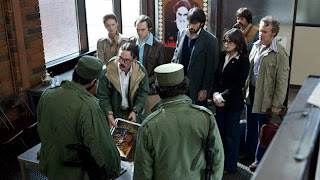
The stakes are high as Mendez and the fugitives are questioned by security
What follows is a suspense-ridden, high stakes game of cat and mouse where the only way to win is if the mice keep a step ahead of the cat at all times. The cinematography creates the illusion of it being shot in the early 1980s, lending a nostalgic, somewhat documentary feel, creating a sense of realism. Although Mendez is clearly the hero of the film there is still a sense of ensemble work from the supporting cast, including a great performance by Bryan Cranston as Mendez's CIA supervisor Jack O'Donnell.
Affleck may never be able to fully shed the horror that was Gigli, but if that old Hollywood adage that you're only as good as your last film holds true then Affleck is going to be ok.
Wednesday, 3 October 2012
Women at War
Last Friday I attended a screening of the documentary The Invisible War (Dir. Kirby Dick, 2012) at the Vancouver International Film Festival. Going in I knew it would be a difficult watch, with a subject matter that revolves around the rape of soldiers in the US military I anticipated that it would be a heavy film. I didn't anticipate however the strong reaction it would have with myself and the audience around me.
The documentary investigates what can only be described as an epidemic of sexual assault in the US military. The statistics tell us that 20% of female soldiers in the US military have been sexually abused. We know from statistics that 80% of sexual abuse victims do not report assaults, therefore the number would in fact be significantly higher. The film introduces us to a number of rape victims from a series of military outfits including the Navy, Marines and Coast Guard. It is nothing short of horrifying listening to their experiences, going from proud, dedicated soldiers to broken victims at the hands of not only the perpetrators, but also the US military.
Hearing their ordeals was difficult enough. The sobs of the audience members around me told me I wasn't alone in this. Where it gets really difficult however is when you find out what the US military did after the victims reported their assaults. That would be a whole lot of nothing. Due to the military's own form of justice the victims had to go through their chain of command to report the abuse. Those in positions of power however are not trained or equipped to deal with such matters, and as one interviewee noted it would be seen as a leadership failure if it got out that there had been an assault in their unit. Therefore the assaults are 'dealt' with by the military, and this usually means that the perpetrator walks off free.
That unfortunately isn't the worst of it. The majority of women who did report abuse ended up being investigated themselves. They were told that their accusations were false, or that they had bought it on themselves. One of the women we see, Kori Cioca received her papers and was discharged after she reported the rape. Her story is particularly tragic. Not only was she sexually violated, she was also physically abused by her attacker, so much so that it broke her jaw. When we see her in the film she has been on a soft diet for two years because of the injuries she received at the hands of the perpetrator. She has been waiting over 14 months for medical aid from the military, and near the end of the film we find out she has been denied. A variety of ridiculous reasons are given, one being that she was two months shy of the two years of service needed in order to be eligible for aid. She was two months short of two years because she was discharged for reporting her attacker. He is currently still working at the US Coast Guard.
The film brings to light the military sexual assault prevention and assault program, which basically consists of telling female soldiers to walk with a buddy, and reminding male soldiers to "ask her when she's sober". When they interview Kaye Whitely, the former director of the program she clearly has no expertise and no actual system in place for rape prevention. The whole program seems to be an attempt to appear as though prevention is in place when it is fact not.
I cannot recommend this film enough. Although the subject matter is heavy and the stories disturbing, it is vital that we bring such atrocities to light and ensure that this does not continue to happen to both men and women in the military. The film encourages us to share this story with friends and to sign this petition: http://www.change.org/petitions/support-military-sexual-assault-survivors, and I encourage you also. Please check out http://invisiblewarmovie.com/ for more information and make sure that you spread the word and ensure that the victims never have to feel invisible again.
The documentary investigates what can only be described as an epidemic of sexual assault in the US military. The statistics tell us that 20% of female soldiers in the US military have been sexually abused. We know from statistics that 80% of sexual abuse victims do not report assaults, therefore the number would in fact be significantly higher. The film introduces us to a number of rape victims from a series of military outfits including the Navy, Marines and Coast Guard. It is nothing short of horrifying listening to their experiences, going from proud, dedicated soldiers to broken victims at the hands of not only the perpetrators, but also the US military.
Elle Helmer
Hearing their ordeals was difficult enough. The sobs of the audience members around me told me I wasn't alone in this. Where it gets really difficult however is when you find out what the US military did after the victims reported their assaults. That would be a whole lot of nothing. Due to the military's own form of justice the victims had to go through their chain of command to report the abuse. Those in positions of power however are not trained or equipped to deal with such matters, and as one interviewee noted it would be seen as a leadership failure if it got out that there had been an assault in their unit. Therefore the assaults are 'dealt' with by the military, and this usually means that the perpetrator walks off free.
Kori Cioca and her husband
That unfortunately isn't the worst of it. The majority of women who did report abuse ended up being investigated themselves. They were told that their accusations were false, or that they had bought it on themselves. One of the women we see, Kori Cioca received her papers and was discharged after she reported the rape. Her story is particularly tragic. Not only was she sexually violated, she was also physically abused by her attacker, so much so that it broke her jaw. When we see her in the film she has been on a soft diet for two years because of the injuries she received at the hands of the perpetrator. She has been waiting over 14 months for medical aid from the military, and near the end of the film we find out she has been denied. A variety of ridiculous reasons are given, one being that she was two months shy of the two years of service needed in order to be eligible for aid. She was two months short of two years because she was discharged for reporting her attacker. He is currently still working at the US Coast Guard.
The film brings to light the military sexual assault prevention and assault program, which basically consists of telling female soldiers to walk with a buddy, and reminding male soldiers to "ask her when she's sober". When they interview Kaye Whitely, the former director of the program she clearly has no expertise and no actual system in place for rape prevention. The whole program seems to be an attempt to appear as though prevention is in place when it is fact not.
I cannot recommend this film enough. Although the subject matter is heavy and the stories disturbing, it is vital that we bring such atrocities to light and ensure that this does not continue to happen to both men and women in the military. The film encourages us to share this story with friends and to sign this petition: http://www.change.org/petitions/support-military-sexual-assault-survivors, and I encourage you also. Please check out http://invisiblewarmovie.com/ for more information and make sure that you spread the word and ensure that the victims never have to feel invisible again.
Sunday, 2 September 2012
There Should Have Only Been One
I'll never forget when I was 17 years old and was at the movies with my father. I can't recall the film we were watching but a trailer came on and my dad, who rarely gets excited about films, couldn't hold back his excitement. The trailer was for The Bourne Identity. My father had read the book and he spoke of it's intrigue and mystery so naturally I had to read it too. I ended up being the only one in the family to read the trilogy. I fell in love with the chaotic world of Bourne. I eagerly anticipated The Bourne Supremacy and was a little stunned to find that they had completely parted ways with the novels, however The Bourne Ultimatum was so much fun I didn't mind at all. The latter two films were directed by Paul Greengrass, a director who is able to keep a handle on the story whilst creating thrilling action scenes. All three Bourne films were written by Tony Gilroy, a very talented screenwriter.
After hearing that Matt Damon didn't want to do another Bourne film I resigned myself to the fact that the films had come to an end. Hollywood however will never let a cash cow die. I was both excited and a little apprehensive when I found out that a new film entitled The Bourne Legacy was being made. When I saw that it was being written by Gilroy I realised that there was nothing to worry about, until I saw that Greengrass was not on board. Rather than replacing Greengrass with an equally skilled director producers handed the reigns to Gilroy, whose directing credits had only two films (Duplicity, Michael Clayton). But what is quantity when there is quality? Peter Jackson was relatively unknown when he took on Lord of the Rings, and look at him today. So I swallowed my doubt and went to watch the fourth Bourne film.
Although the film is called The Bourne Legacy this is not a film about Bourne. He is merely the tip of the iceberg as the film quotes. This installment follows Aaron Cross (Jeremy Renner), a soldier who is part of a program designed to create super soldiers. After the CIA failed to capture Bourne they go into disaster mode and decide to shut the program down, which basically consists of killing everyone involved. On that list is Cross and Dr. Marta Shearing (Rachel Weisz) a scientist who administers the medication to the soldiers. Cross and Shearing go on the run from the relentless Col. Eric Byer (Edward Norton) and his team who sit in the comfort of their office whilst tracking the two down. In the previous Bourne films Jason fought to catch up with the CIA, to find out the truth he desperately searched for. In this latest film it is the CIA who are trying to catch up, and they really aren't very good at it, Cross and Shearing are always two steps ahead.
Cross is not Bourne and the film takes great pains to remind us of that. The source of his super strength is from the medications he's been taking, whereas Bourne's skill set was purely from training. If this was Batman Cross would be Robin. Cross also has his memory, he knows his past, he figures out quickly what's going on and he is able to make decisions based on those facts. Shearing has a much more important part in the film than women in previous Bourne films. Cross would not have been able to survive without her. Both Renner and Weisz have great chemistry on screen. Although their characters are never shown to be physically involved there are more than enough glances and hand touching to get the point across.
Renner is a great upcoming actor who I believe has a long successful career ahead of him. With films like The Town, The Hurt Locker, Mission: Impossible - Ghost Protocol and The Avengers behind him he already has made a name for himself in tinseltown. He brings vulnerability and integrity to Cross and you really can't help but root for the guy. Perhaps if this was it's own film, without the Bourne name being attached to it then there would have been more opportunity to explore this character more. As it is however Cross seems as though he's always two steps ahead of the CIA but three feet deep in Bourne's shadow. Anything he can do Bourne can do better.
The main issue with this film is the directing. The marriage of Greengrass' direction and Gilroy's script in the previous two films meant that both story and visual were at their best. With Gilroy wearing both screenwriter and directing hats there was a loss in quality of both. The greatest flaw is the ending, or lack thereof. There is a spectacular motorbike chase scene and then two minutes after that ends we hear that famous Moby song signaling the end of the film. It came on so abruptly that I felt there must have been a mistake. And there was. Gilroy forgot to write an ending. The hollywood demon must have sat on his shoulder all along because the film sets itself up for sequels. The problem however is that the film can't stand alone, whereas all three previous Bourne films could. So many questions are asked, very few answered. I have a feeling we may never get them answered.
My recommendation is that you go see this film knowing that you'll get great action scenes, talented actors playing underwritten roles, and an incomplete story. This is not a Bourne film, Jason Bourne jumped off that roof and perhaps we will never see him again...but remember, this is Hollywood and cash cows never die.
Subscribe to:
Posts (Atom)


